
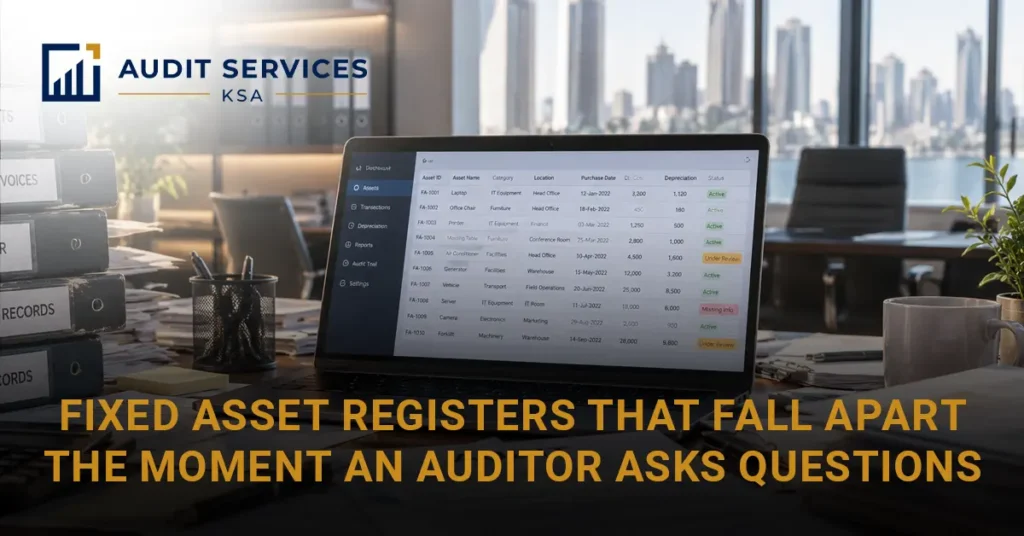
It usually happens in the first hour of fieldwork. The auditor picks one line from the register, walks to the warehouse, and asks to see the asset. Ten minutes later, nobody can find it, or worse, it was scrapped two years ago and never removed from the books. That single moment is often when a routine fixed asset register audit stops being routine. Audit Services KSA, we sit through this scene often enough to know it’s rarely about dishonesty. It’s about a register that was built once and never maintained since.
The Moment Everything Falls Apart
Most owners assume their asset register is fine because the total on the balance sheet looks reasonable. But a fixed asset register audit doesn’t test totals; it tests individual items, one tag at a time. Auditors trace a sample from the register to the physical floor, and separately from the floor back to the register. Any asset that can’t be located, or any asset sitting on the floor with no matching entry, becomes an exception. Enough exceptions, and the auditor stops trusting the whole schedule.
This is where an asset register discrepancy ksa companies face becomes visible for the first time. Assets purchased under one department’s budget get recorded under another. Serial numbers are typed once and never checked again. Depreciation continues on machines that were sold at scrap value years ago. None of these are dramatic frauds; they’re small gaps that accumulate quietly until an audit forces them into the open.
Why Registers Fail Under Pressure
A register usually starts clean when it is first created or migrated to new software. Problems begin when daily operations move faster than the paperwork.
Fixed Asset Registration Issues
- A branch relocates and moves furniture without informing finance.
- A machine breaks down and is used for spare parts, but the asset entry remains open.
- Asset tags fall off equipment, especially when items are kept outdoors.
- Asset transfers and changes are not updated in the register on time.
Each issue may seem minor on its own. Over time, however, these gaps can make the register inaccurate and difficult to rely on.
Common Fixed Asset Audit Findings
When the fixed asset register audit finally happens, these gaps can appear as fixed asset audit findings, including:
- Missing assets
- Unrecorded disposals
- Duplicate entries
- Incorrect asset locations
These findings can delay the audit report and raise questions about internal controls. A business that cannot reliably track its own equipment may also face greater scrutiny of other control processes.
What Auditors Actually Look For
A fixed asset verification audit typically checks four things: existence (is the asset physically there), completeness (is every owned asset recorded), valuation (is the carrying value correct), and rights (does the company actually own it, or is it leased or pledged). Owners often prepare for existence alone, forgetting that completeness failures assets that exist but were never entered are just as common, and just as damaging to the opinion an auditor is willing to give.
| Common Register Problem | Typical Audit Impact |
| Asset physically missing, still on register | Existence exception, possible impairment |
| Asset present, never recorded (off-register) | Completeness exception, understated assets |
| Wrong location or custodian noted | Delayed verification, extended testing |
| Depreciation continuing after disposal | Overstated net book value |
| Duplicate tags or entries | Overstated asset count |
Businesses that need to verify what is physically on-site against what appears in the books can use Fixed Asset Management Services for asset verification, tagging, register reconciliation, and identification of missing, unrecorded, duplicated, or incorrectly classified assets before those differences become audit exceptions.
Reducing Asset Register Audit Risk
Asset register audit risk rises fastest in businesses with multiple sites, frequent equipment moves, or high staff turnover in the store or facilities team. The fix isn’t a bigger spreadsheet; it’s a tighter process. Every acquisition needs a tag number assigned before the invoice is even paid. Every disposal needs a signed form before the entry is closed, not after. Every year, a physical count should be reconciled against the register, with differences investigated rather than adjusted away silently.
Barcode or QR tagging removes much of the guesswork, since a scan confirms both the asset’s identity and its location in seconds. For businesses without that technology yet, even a simple annual walk-through with a printed register and a pen catches most of the drift before it becomes a finding.
Building a Register That Survives Scrutiny
The businesses that pass a fixed asset register audit cleanly share a habit: they treat the register as a living document, not an annual chore. Additions, transfers, and disposals get logged the same week they happen, not backdated during audit prep. Depreciation policies are applied consistently across categories instead of adjusted case by case. And someone usually finance, sometimes operations owns the register full time, so questions have a clear answer instead of a shrug.
How Often Should a Fixed Asset Register Audit Happen
Annually is the norm for statutory purposes, but a light internal check every quarter catches problems while they’re still small. Waiting a full year to reconcile the register against reality is how a handful of missing tags turns into a page of exceptions in the final report.
Getting Documents Ready Before the Audit Team Arrives
Preparation is where most of the pain in a fixed asset register audit can be avoided entirely. Long before fieldwork starts, pull together purchase invoices for every addition made in the year, disposal approvals for anything written off, and insurance schedules that should, in theory, mirror the register. Any mismatch between these documents and the register itself is worth resolving internally first, because it’s far cheaper to fix a gap in-house than to explain it to an external reviewer under time pressure.
It also helps to walk a small sample yourself before the auditor does. Pick a handful of high-value items across different locations, confirm the tag, condition, and location match what’s recorded, and correct anything that doesn’t. This kind of dry run tends to surface the same asset register discrepancy ksa teams later find during the real audit, except now there’s time to fix it quietly instead of explaining it on the spot.
Common Mistakes That Trigger Exceptions
A few mistakes appear repeatedly during a fixed asset register audit. Most are simple process issues, but they can create unnecessary audit exceptions.
- Undocumented asset transfers: Assets are moved between branches with a phone call instead of a written transfer form, leaving the register with the old location.
- Disposed assets still on the register: Fully depreciated assets remain listed even after they have been scrapped or removed from service.
- Poor tracking of IT equipment: Software, computers, and other IT assets are often difficult to track because they are smaller, move frequently, and change hands quickly.
- Delayed register updates: Changes are recorded weeks or months later instead of being updated when they happen.
Fixing these issues usually does not require a new system. The key is to update the register on the same day an asset is acquired, transferred, or disposed of. This simple habit can prevent many audit exceptions and keep asset register audit risk under control.
Conclusion
A clean register isn’t built during audit season; it’s built by treating every acquisition and disposal as an entry that matters the day it happens. Firms that get this right walk into fieldwork with confidence instead of dread, because nothing on the schedule surprises them anymore. Every tag matches a physical item, every disposal has a paper trail, and every location note reflects where equipment actually sits today. That consistency is what turns audit season from a scramble into a formality.
If your business needs a second pair of eyes before the auditor asks the first question, Audit Services KSA can help you get there by reviewing the register, spot-checking high-risk categories, and closing gaps before they become findings on someone else’s report.
Frequently Asked Questions
What triggers most fixed asset audit findings?
Untracked disposals and undocumented transfers between locations. Both are simple to prevent but easy to overlook without a defined process.
How is an asset register discrepancy in KSA usually resolved?
Through a physical count reconciled against the register, with each difference investigated and documented rather than silently written off.
Does a fixed asset verification audit cover leased equipment?
Yes. Auditors confirm rights and obligations, so leased or pledged assets need separate, clear treatment in the register.
What’s the biggest driver of asset register audit risk?
Multiple locations combined with weak disposal documentation. Assets move faster than paperwork updates.
Can small businesses skip a formal fixed asset register audit?
Not if a statutory audit or financing requires it. Even without that requirement, an annual check protects against loss and misstatement.