
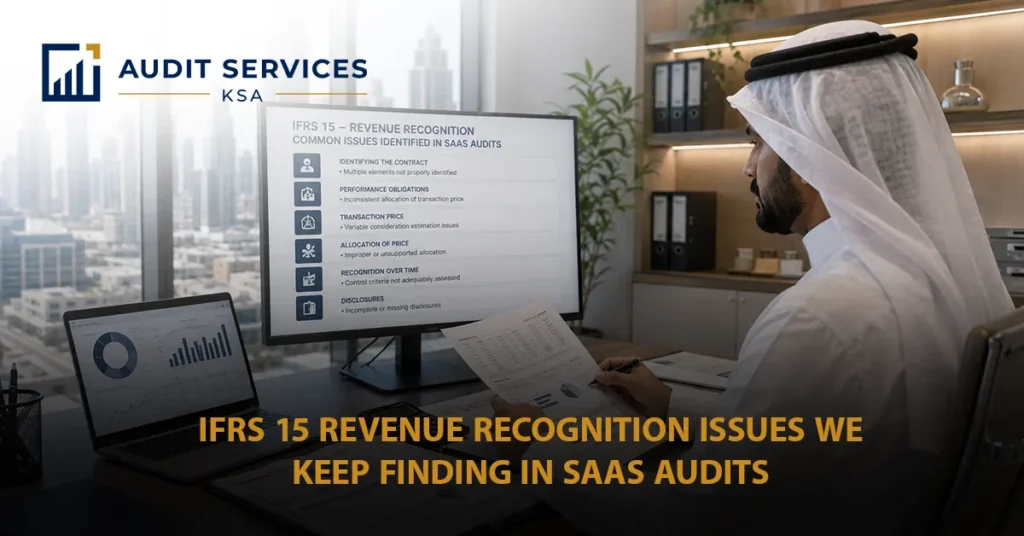
SaaS businesses often have simple-looking billing models, but revenue can become difficult to account for when contracts include subscriptions, implementation, upgrades, usage fees, support, and bundled services. This is where an IFRS15 revenue recognition audit becomes important. The key question is not simply when an invoice is raised, but when the related service is delivered and how each promise in the contract should be treated.
For businesses operating in Saudi Arabia, accurate revenue recognition supports reliable financial reporting and a smoother year-end audit. Audit Services KSA helps businesses review revenue processes, identify accounting gaps, and strengthen supporting documentation before these issues become audit adjustments. A practical review can help management understand where revenue recognition is exposed and which controls need improvement.
Why IFRS 15 Revenue Recognition Is a Common SaaS Audit Problem in Saudi Arabia
SaaS contracts can contain several services and pricing terms, making revenue recognition more complex than simply matching invoices with income.
- Subscription access may need to be recognized over the period in which the customer receives the service.
- Implementation or onboarding services may require separate assessment.
- Non-refundable upfront fees may not qualify for immediate revenue recognition.
- Usage-based or performance-based fees can create variable consideration.
- Contract modifications may change the accounting treatment of an existing arrangement.
- Discounts and bundled services can create challenges when allocating the transaction price.
An IFRS15 revenue recognition audit should look beyond the general ledger and review customer contracts, billing terms, service delivery, and revenue schedules. This wider review can reveal timing errors that would not be obvious from the ledger alone.
Common Contract Identification Errors in SaaS Revenue Recognition
The first step is understanding what the customer has actually agreed to purchase. A contract may look like one arrangement from a billing perspective while containing several promises that require separate accounting consideration.
- Confirm that the customer contract meets the relevant IFRS 15 criteria.
- Review subscription access separately from implementation and professional services.
- Assess whether customer training is a distinct service.
- Review custom development or integration work based on the actual contract terms.
- Consider whether renewal options or additional user rights affect the arrangement.
- Compare contractual terms with invoices and revenue schedules to identify inconsistencies.
A practical SaaS audit KSA review should connect the contract, sales system, billing platform, and accounting records. This helps finance teams identify differences between what was sold and what was ultimately recognized as revenue.
Performance Obligations: When SaaS Services Should Be Separated
A SaaS contract should not automatically be treated as one performance obligation simply because everything appears on the same invoice.
- Determine whether SaaS access provides a distinct service.
- Assess whether implementation activities provide a separate customer benefit.
- Review data migration services separately where they represent an independent service.
- Consider whether training is distinct from the core subscription.
- Assess customisation and integration work based on the specific arrangement.
- Document the reasoning used to combine or separate performance obligations.
The main question is whether the customer can benefit from a promised service on its own or together with other readily available resources. The conclusion should be documented and applied consistently across similar contracts.
Subscription Revenue: Recognizing Revenue Over the Contract Service Period
For a typical SaaS subscription, billing and revenue recognition are not necessarily the same event. If a customer pays for twelve months of access upfront, the business needs to consider the service period when determining when revenue is recognized. Recognizing the entire amount on the invoice date can create a timing error when the related service has not yet been provided.
Finance teams should maintain a clear reconciliation between invoices, cash receipts, contract liabilities, and recognized revenue. They should also review cancellations, upgrades, renewals, and service interruptions because these events may affect the revenue schedule. A subscription revenue audit should check whether revenue is recognized consistently with the contractual service period and whether deferred amounts are properly supported.
This becomes particularly important at year-end, when large billings close to the reporting date can receive additional audit attention. A documented monthly review can help identify unusual movements before the financial statements are finalized.
Upfront Fees and Implementation Charges Under IFRS 15
Upfront fees are an area where SaaS companies can recognize revenue too early. The accounting treatment depends on what the fee represents and whether the related activity provides a separate service.
- Determine whether the upfront fee relates to a distinct service.
- Assess whether the customer receives a separate benefit from implementation.
- Review activation and setup activities rather than relying only on the invoice description.
- Consider whether an upfront amount represents an advance payment for future services.
- Match implementation revenue with the applicable performance obligation.
- Maintain documentation supporting the conclusion for each significant contract type.
Variable Consideration in Usage-Based and Tiered SaaS Contracts
SaaS pricing can include charges based on customer usage, transaction volumes, performance, or other measures. These terms require careful review because the amount ultimately recognized may differ from the amount initially expected.
- Identify usage-based charges included in the customer arrangement.
- Review volume discounts and tier-based pricing.
- Assess rebates, credits, refunds, and service-level concessions.
- Consider whether performance-based amounts are subject to the variable consideration constraint.
- Reassess estimates when relevant facts and customer usage change.
- Reconcile system-generated usage data with invoices and revenue records.
Finance teams should have a documented process for estimating variable consideration rather than relying only on amounts already billed. This is particularly important where customer usage is measured through users, transactions, API calls, storage, or other automated metrics.
Contract Modifications, Renewals, Upgrades, and Downgrades
Changes to SaaS contracts can create accounting issues when sales or billing teams process them without informing finance.
- Review additional users added during the contract period.
- Assess whether an upgraded package creates a new contract or modifies an existing one.
- Review downgrades and their effect on future consideration.
- Assess renewals containing new pricing, products, or services.
- Review changes to contract duration and service scope.
- Check amendments, side agreements, and customer concessions.
- Reconcile CRM changes with revenue accounting records.
A contract modification should be assessed based on its actual terms and circumstances. Simply changing an invoice or updating a customer account in the billing system does not determine the appropriate accounting treatment. A clear approval workflow between sales, legal, billing, and finance can reduce the risk of unrecorded modifications.
Stand-Alone Selling Prices and Revenue Allocation Errors
When a SaaS contract contains multiple performance obligations, the transaction price may need to be allocated based on the relative stand-alone selling prices of the promised services.
- Establish how the stand-alone selling price of the SaaS subscription is determined.
- Support the selling price of implementation and professional services.
- Review discounts included in bundled arrangements.
- Use observable prices where reliable evidence is available.
- Document estimation methods where a stand-alone selling price is not directly observable.
- Reassess pricing assumptions when products, packages, or market conditions change.
Weak documentation around stand-alone selling prices can make a reasonable revenue conclusion difficult to support during an audit. Finance teams should retain pricing evidence, calculations, assumptions, and approval records.
SaaS Revenue Audit Red Flags KSA Finance Teams Should Watch
Certain patterns can indicate that revenue recognition needs a closer review before the financial statements are finalized.
- Large manual revenue entries posted near year-end.
- Significant invoices raised shortly before the reporting date.
- Immediate recognition of non-refundable upfront fees.
- Contract liabilities that do not reconcile with billing records.
- Revenue schedules that do not agree with customer contracts.
- Similar SaaS contracts receiving inconsistent accounting treatment.
These warning signs do not automatically mean an accounting error exists. They indicate areas where management should perform additional review and retain clear evidence for its conclusions. An effective revenue recognition issues audit should also investigate unusual movements rather than relying only on materiality thresholds.
How Audit Services KSA Helps Strengthen SaaS Revenue Compliance
A strong revenue process should be built before the audit rather than corrected after an auditor identifies an issue. Audit Services KSA takes a compliance-centered approach by reviewing SaaS contracts, mapping contractual promises to performance obligations, assessing revenue schedules, and checking supporting documentation.
The review can also examine how sales, CRM, billing, and finance systems interact because a weakness in one system can affect the final revenue figure. Audit Services KSA can help management identify potential revenue recognition risks early, improve documentation, and establish repeatable review procedures.
For growing SaaS businesses, this approach can make the audit process more organized and reduce the risk of unexpected revenue adjustments. A pre-audit review also gives finance teams a clearer view of significant judgements that require management approval and supporting evidence. An IFRS15 revenue recognition audit can therefore become part of a proactive compliance process rather than only a year-end exercise.
Conclusion
Accurate revenue recognition helps SaaS businesses maintain reliable financial statements and avoid unexpected audit adjustments. Reviewing contracts, performance obligations, subscription periods, upfront fees, variable consideration, and contract changes can help finance teams identify issues before year-end.
Audit Services KSA helps businesses strengthen their revenue processes through practical reviews, documentation checks, control assessments, and audit-ready support. Our approach focuses on identifying gaps early and helping management apply consistent accounting procedures across customer contracts. With clear documentation and effective controls, SaaS businesses can reduce revenue recognition risks, improve financial reporting, and approach their audits with greater confidence.
FAQs
1. What is IFRS 15 revenue recognition?
IFRS 15 sets rules for recognizing revenue from contracts with customers based on when performance obligations are satisfied.
2. Is IFRS15 Saudi Arabia applicable to SaaS businesses?
Yes, SaaS businesses reporting under Saudi financial reporting requirements need to consider applicable IFRS 15 requirements.
3. Should SaaS subscription revenue be recognized when the customer pays?
No, revenue is generally recognized based on when the contracted SaaS service is provided, not simply when payment is received.
4. Are upfront SaaS implementation fees always recognized immediately?
No, the treatment depends on whether the implementation service is distinct or relates to future services.
5. Why do SaaS companies face revenue recognition challenges?
SaaS contracts often combine subscriptions, implementation, usage fees, discounts, upgrades, and other terms that require careful accounting analysis.